
Extensive and Potential Life-Threatening Bilateral Neck Swelling Post-Tonsillectomy: A Case Report
Mohammed A Elkrim S. Mohammed, Syed Zohaib Maroof Hussain*, Mohammed Yousif
ENT, University Hospital of Leicester NHS Trust, Leicester, United Kingdom
*Corresponding Author: Mr. Syed Zohaib Maroof Hussain, Core Surgical Trainee, ENT, University Hospitals of Leicester NHS Trust, Leicester, United Kingdom
Received: 17 March 2025; Accepted: 13 April 2026; Published: 22 April 2026
Article Information
Citation: Mohammed A Elkrim S. Mohammed, Syed Zohaib Maroof Hussain, Mohammed Yousif. Extensive and Potential Life-Threatening Bilateral Neck Swelling Post-Tonsillectomy: A Case Report. Archives of Clinical and Medical Case Reports. 10 (2026): 93-95.
View / Download Pdf Share at FacebookAbstract
Objective: This paper reports an unusual case of post-tonsillectomy emphysema and pneumomediastinum.
Methods: This is a clinical case report with a review of literature.
Results: Tonsillectomy is one of the most common otolaryngological procedures. It is a safe procedure, however, there are some complications typically associated with tonsillectomy. A 28-year-old female presented with a less than one-day history of extensive right-sided tender neck swelling. The patient underwent bilateral tonsillectomy, which was uneventful, but subsequently developed a sudden onset of right-sided neck swelling on the zero-post-operative day. Extensive crepitus was felt on palpation. Examination findings were confirmed by imaging. The patient was conservatively managed and subsequently discharged home.
Conclusion: Post-tonsillectomy surgical emphysema and pneumomedia stinum are rare complications. Pneumomediastinum and bilateral neck involvement made our case rather unique. Surgical technique plays an important role, especially in the adhesions of tissues. Patients should be managed conservatively under close observation. Avoidance of coughing and straining will help to prevent the worsening.
Keywords
Eustachian tuboplasty; Subcutaneous emphysema; Valsalva maneuver; Balloon dilatation of Eustachian tube
Article Details
1. Introduction
Tonsillectomy is one of the most common otolaryngological procedures. It is a safe procedure, however, there are some complications typically associated with tonsillectomy [1]. Frequently reported complications include bleeding, infection, pain, damage to teeth, odynophagia, nausea, vomiting, and otalgia [2]. Surgical emphysema is an unusual and rare complication after tonsillectomy [3]. It can be managed conservatively, however, in some cases, emphysema can extend to the upper airway and cause airway obstruction or to the thorax leading to pneumomediastinum [4, 5]. Post tonsillectomy emphysema is a life-threatening presentation and needs immediate attention [3, 5]. Here we report an unusual case of post-tonsillectomy emphysema and pneumomediastinum. Bilateral neck involvement made our case rather unique.
2. Case Presentation
A 28-year-old female presented to our emergency department (ED) with a less than one-day history of extensive right-sided neck swelling associated with pain, difficult mouth opening and mild odynophagia. In addition, she reported choking episodes and shortness of breath upon lying. No other symptoms were reported. Upon questioning, she further reported that a small swelling started immediately after the tonsillectomy which was 20 hours ago. However, the patient did not seek medical attention and left the hospital. She was fit and well otherwise.
A comprehensive Ear, Nose and Throat (ENT) examination was performed which revealed right-sided generalised extensive swelling starting from the right temporal mandibular joint (TMJ) to the base of the neck. Swelling was tender to touch, and crepitus was felt on palpation. Limited mouth opening was also noticed. Flexible nasal endoscopy showed a patent airway with mildly swollen epiglottis and increased pooling of saliva in the vallecula. Bloods showed raised white cell count (23.1) including neutrophil (19.4) and C-reactive protein was 46. Computed tomography (CT) scan showed extensive surgical emphysema bilaterally more on the right side, starting from the base of skull and extending down to the base of the thyroid (Figure 1 and 2).
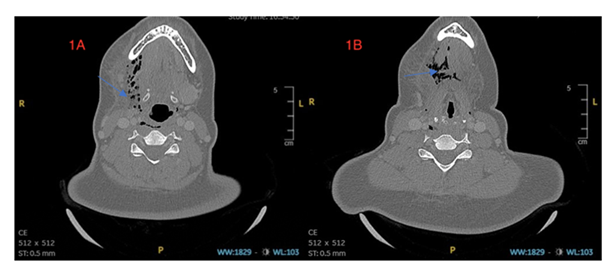
Figure 1: A) Axial view of a CT scan showing surgical emphysema at the level of right submandibular area. B) Axial view of a CT scan showing the extend of emphysema to the floor of the mouth
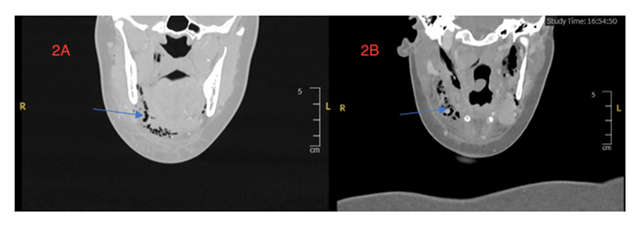
Figure 2: A & B Coronal view CT scan of the neck showing surgical emphysema at the level of right submandibular space
Patient was immediately admitted under ENT and commenced on intravenous (IV) antibiotics, fluids, stat dexamethasone, and analgesia. Case was discussed with an on-call anaesthetist as well for advice regarding precautionary intubation, who advised managing a patient conservatively in the airway ward with close observation.
We kept the patient nil by mouth (NBM). Following day, the patient-reported improvement in her symptoms and her neck swelling was reduced as well. Patient was feeling better, and her swelling had gone down completely. Patients were sent home on oral antibiotics with safety netting and advice against heavy lifting and straining.
3. Discussion
Subcutaneous emphysema is a rare but potentially life-threatening complication of tonsillectomy [6]. Recurrent history of tonsillitis and peritonsillar abscess, increases the risk of subcutaneous emphysema [7]. Our patient had bilateral tonsillectomy due to recurrent tonsillitis. The exact pathophysiology of surgical emphysema is still unclear, however, there are different theories explaining the mechanism [8]. It can be surgical or anaesthetic-related. Trauma to a muscle during the tonsillectomy can lead to entrapment of air into the tissue planes. Similarly, traumatic intubation can cause air leak and can lead to surgical emphysema [9]. It usually happens immediately after the surgery with small swelling. However, rarely it can involve mediastinum as well and lead to pneumomediastinum, like in our patient.
Post tonsillectomy cervicofacial swelling with crepitus on examination is a strong indicator of surgical emphysema. Like in our patient, we felt crepitus on palpation. In addition, our patient had pain, mild odynophagia, and trismus as well. These signs were suggestive of pneumomediastinum [3]. Plain radiographs and CT scans show air in subcutaneous spaces and confirm the diagnosis [10]. In our patient CT scan showed extensive surgical emphysema from the base of the skull to the base of the thyroid. Interestingly, CT scan in the patient showed bilateral neck emphysema, more on right. In the majority of the cases, patients were managed conservatively [1-3]. Patients should be admitted to the hospital for airway monitoring and respiratory compromise. In addition, patients should be commenced on broad-spectrum antibiotics to treat or prevent any life-threatening infection [11]. The aim of treatment is to prevent further progression of the condition. Therefore, extra caution should be taken by the patient to avoid air tracking within tissue planes by avoiding actions that increase upper airway pressure such as coughing or straining [10]. Similarly in our patient, we started her on IV antibiotics and advised her against the action that can lead to the progression of surgical empyema. Like other cases, our patient recovered completely, and we sent her home on oral antibiotics and advised against the Valsalva, coughing, heavy lifting and straining. Rarely are patients mandated a period of ventilation by intubation or tracheostomy [12].
4. Conclusion
Post-tonsillectomy surgical emphysema and pneumomediastinum are rare complications. Pneumomediastinum and bilateral neck involvement made our case rather unique. Surgical technique plays an important role, especially in the adhesions of tissues. Patients should be managed conservatively under close observation. Avoidance of coughing and straining will help to prevent the worsening.
Funding Statement
None
Acknowledgements
None
Informed Consent/ Patient Consent
Yes obtained
Trial Registration Number/Date
Not applicable
Grant Number
Not applicable
Ethical Statement
Informed consent has been obtained from the patient
Conflict of Interest Statement
None
Data Availability Statement
Not appliable
References
- D Kendrick, K Gibbin. An audit of the complications of paediatric tonsillectomy, adenoidectomy and adenotonsillectomy. Clinical Otolaryngology and Allied Sciences 18 (1993): 115-117.
- Randall DA, Hoffer ME. Complications of tonsillectomy and adenoidectomy. Otolaryngol Head Neck Surg 118 (1998): 61-68.
- Kim JP, Park JJ, Kang HS, et al. Subcutaneous emphysema and pneumomediastinum after tonsillectomy. Am J Otolaryngol 31 (2010): 212-215.
- Hung MH, Shih PY, Yang YM, et al. Cervicofacial subcutaneous emphysema following tonsillectomy: implications for anesthesiologists. Acta Anaesthesiol Taiwan 47 (2009): 134-137.
- Koukoutsis G1, Balatsouras DG, Ganelis P, et al. Subcutaneous emphysema and pneumomediastinum after tonsillectomy. Case Rep Otolaryngol (2013): 154857.
- Alzahrani RA. Subcutaneous emphysema after tonsillectomy: a case report and literature review. MedCrave Online J Surg 8 (2020): 27-30
- Mahmood AN Uncommon but potential life-threatening complication after tonsillectomy: post-tonsillectomy cervicofacial surgical emphysema. BMJ Case Rep (2018): 0-2017.
- Nishino H, Kenmochi M, Kasugai S, et al. Subcutaneous emphysema secondary to tonsillectomy: a case report. Auris Nasus Larynx 30 (2003): S135-S136.
- VosGD, MarresEH, HeinemanE, et al. Tension pneumoperitoneum as an early complication after adenotonsillectomy. J Laryngol Otol 109 (1995): 440-441.
- Yelnoorkar S, Issing W. Cervicofacial Surgical Emphysema following Tonsillectomy. Case Rep Otolaryngol (2014): 746152.
- Saravakos P, Taxeidis M, Kastanioudakis I, et al. Subcutaneous emphysema as a complication of tonsillectomy: a systematic literature review and case report. Iran J Otorhinolaryngol 30 (2018): 3-10.
- M-H Hung, P-Y Shin, Y-M Yang, et al. Cervicofacial subcutaneous emphysema following tonsillectomy: implications for anesthesiologists. Acta Anaesthesiologica Taiwanica 47 (2009): 134-137.

 Impact Factor:
* 5.3
Impact Factor:
* 5.3
 Acceptance Rate:
75.63%
Acceptance Rate:
75.63%
 Time to first decision: 10.4 days
 Time from article received to acceptance:
2-3 weeks
Time from article received to acceptance:
2-3 weeks
